If you have followed the debate over English teaching jobs in Korea, it is easy to think the entire foreign job market begins and ends with an E-2 visa. It does not. A software developer, an overseas sales specialist, a factory worker and a seasonal farm worker may all be employed in Korea, yet their jobs—and the routes that allow them to work—are very different.
That distinction matters more than ever in 2026. Our recent look at AI and the E-2 teaching market asked what is changing inside the classroom. The next question is broader: if you want to work in Korea outside teaching, where is the work, and which doors are actually open to you?
The answer starts with an employment survey, then moves to the part that job lists often leave out: immigration status.
The job market is bigger than the teaching conversation
In the latest national survey available as of September 2026, 1.109 million foreign residents were employed in Korea in May 2025, up from 1.010 million a year earlier. The survey counts foreign residents aged 15 or older who had stayed in Korea for at least 91 days. The foreign employment rate was 65.5%. The unemployment rate also rose, to 6.4%, as more people participated in the labor market. A growing number of workers does not mean every applicant finds it easy to get a job.
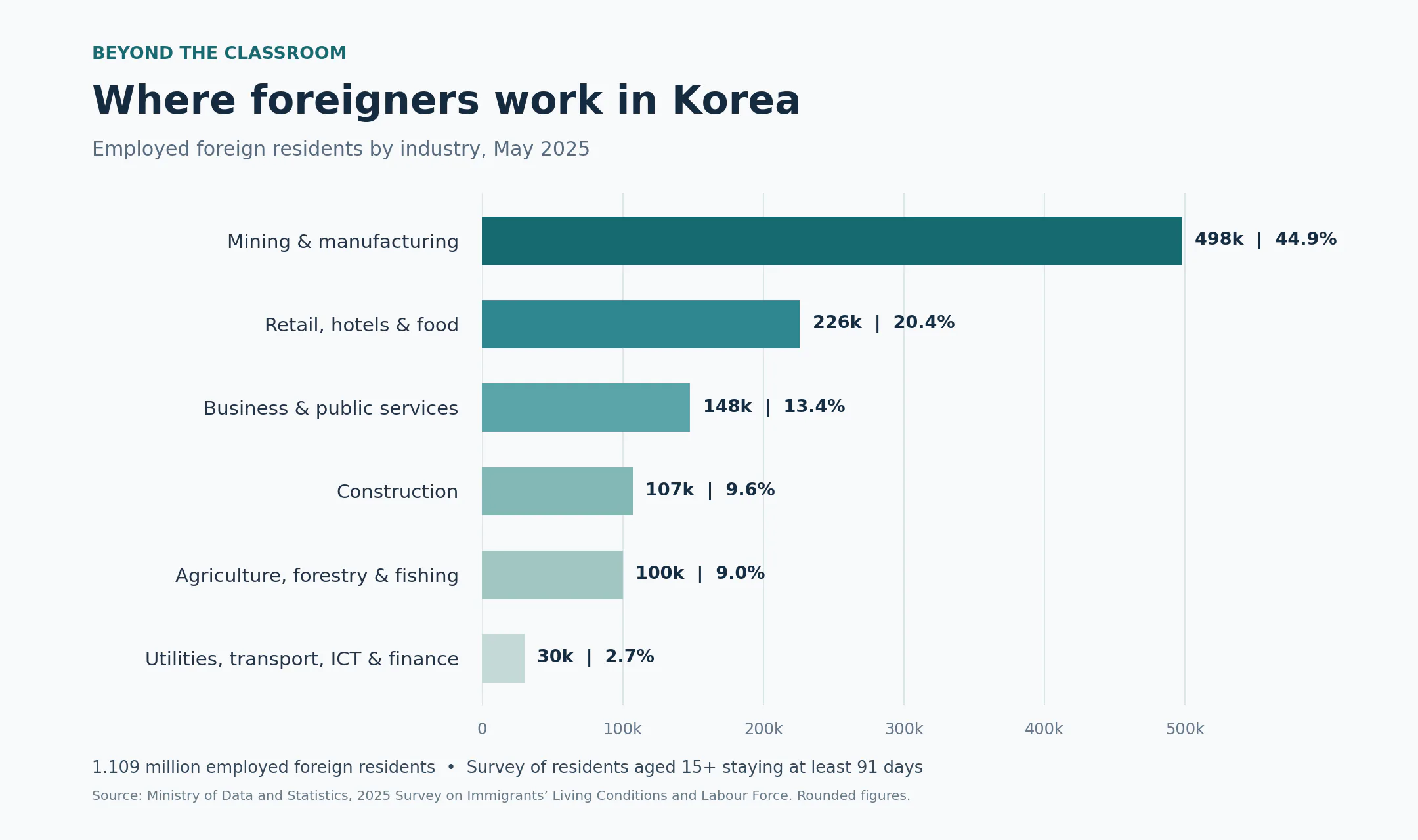
Where were those workers employed? Nearly 498,000, or 44.9%, worked in mining and manufacturing. Another 226,000, or 20.4%, were in the broad group covering wholesale and retail trade, accommodation and food services. Business, personal and public services accounted for 148,000 (13.4%); construction for 107,000 (9.6%); agriculture, forestry and fishing for 100,000 (9.0%); and utilities, transport, communications and finance for 30,000 (2.7%).
[Inline chart: Where foreigners work in Korea — 2025 industry distribution]
Chart caption: Employed foreign residents by industry, May 2025. Figures are rounded and describe people already working, not job vacancies. Source: Ministry of Data and Statistics, 2025 Survey on Immigrants' Living Conditions and Labour Force.
These are industries, not individual occupations. The chart cannot tell you how many people teach English, work as developers or hold a particular visa. It does show why a story about foreign employment in Korea needs to reach beyond the classroom.
One country, several very different job routes
Think of foreign work in Korea as several lanes that meet in the same economy, rather than one open job board. A skilled specialist may qualify for a designated E-7 occupation. An international graduate may need a permitted job-search or employment status before starting a full-time role. An E-9 worker enters through the Employment Permit System for eligible sectors. E-8 is a seasonal route tied to agricultural and fishery labor needs.
Those labels are not interchangeable. The fact that an employer wants to hire you—or that a similar job appears in a search result—does not itself establish that your current visa permits the work. An E-2 English teacher should not assume a new offer automatically authorizes work in an E-7 role. The occupation, qualifications, employer and immigration approval all matter.
Professional jobs: from software to overseas sales
Korea's government-run Study in Korea employment portal sorts opportunities into fields such as IT and software, marketing, design, trade and logistics, manufacturing and services. Its employment guidance identifies specific E-7 occupations, including software developers, designers, overseas sales representatives, interpreters, hotel receptionists and chefs, subject to the rules for each occupation.
That is a more useful starting point than the vague promise of an “English-speaking office job.” A company selling abroad might need someone with regional market knowledge and sales experience. A technology firm may need a developer whose skills match a designated role. A hospital-related position or hotel role has its own requirements. Language ability can help, but it is not a substitute for the role's qualifications or the employer's visa documents.
For some graduates of Korean institutions, D-10 job-seeking status can provide a route to pursue eligible professional employment. It is a job-search status, not a blanket right to take any paid job. The precise conditions should be checked for the person's education and current status before accepting an offer.
Factories and other E-9 workplaces
Manufacturing's large share in the employment survey should not be confused with a promise of open factory jobs for every foreign applicant. The E-9 Employment Permit System has its own eligible countries, sectors, selection process and Korean-language testing. Employers apply for permits through the Korean system; it is not the same process as sending an ordinary résumé to an E-7 employer.
The 2026 policy illustrates both the scale and the limits of this route. The government set an 80,000-person E-9 intake ceiling for 2026, down from 130,000 in 2025. In the fourth 2026 employer permit round announced in September, the initial sector allocations totaled 12,357: 9,020 for manufacturing, 1,906 for agriculture and livestock, 897 for fishing, 394 for construction and 140 for services. These are permit allocations for employers, not 12,357 public vacancies that any foreign resident can apply for. Nor does a smaller annual intake ceiling mean that the existing E-9 workforce has shrunk by 50,000.
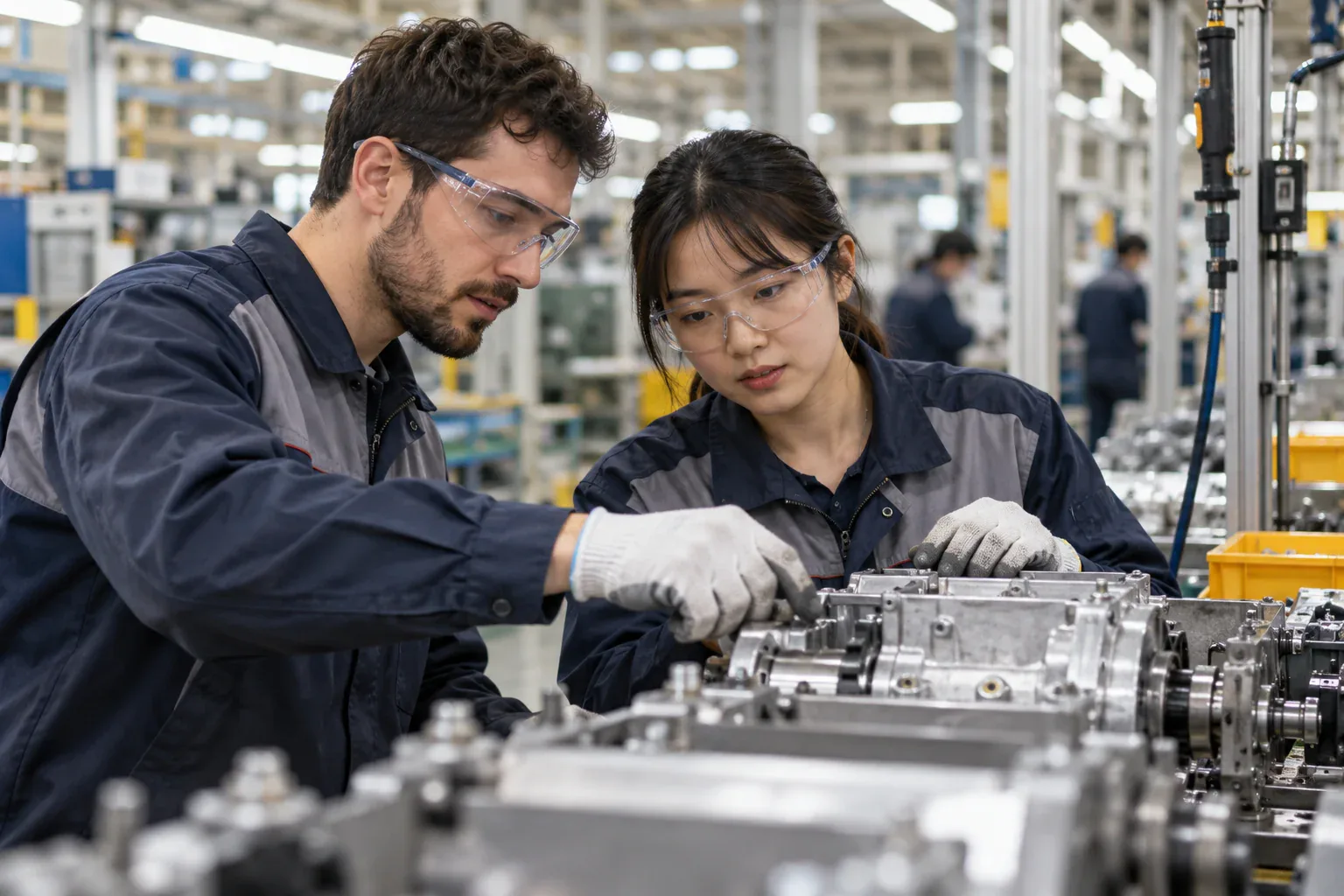
The reality behind the numbers is physical work, workplace safety, location and a contract—not just a visa category on a chart. For someone comparing paths, the working conditions and recruitment channel deserve as much attention as the headline figure.
[Inline photo 1: two colleagues inspecting machinery at a manufacturing plant]
Seasonal work has a different rhythm
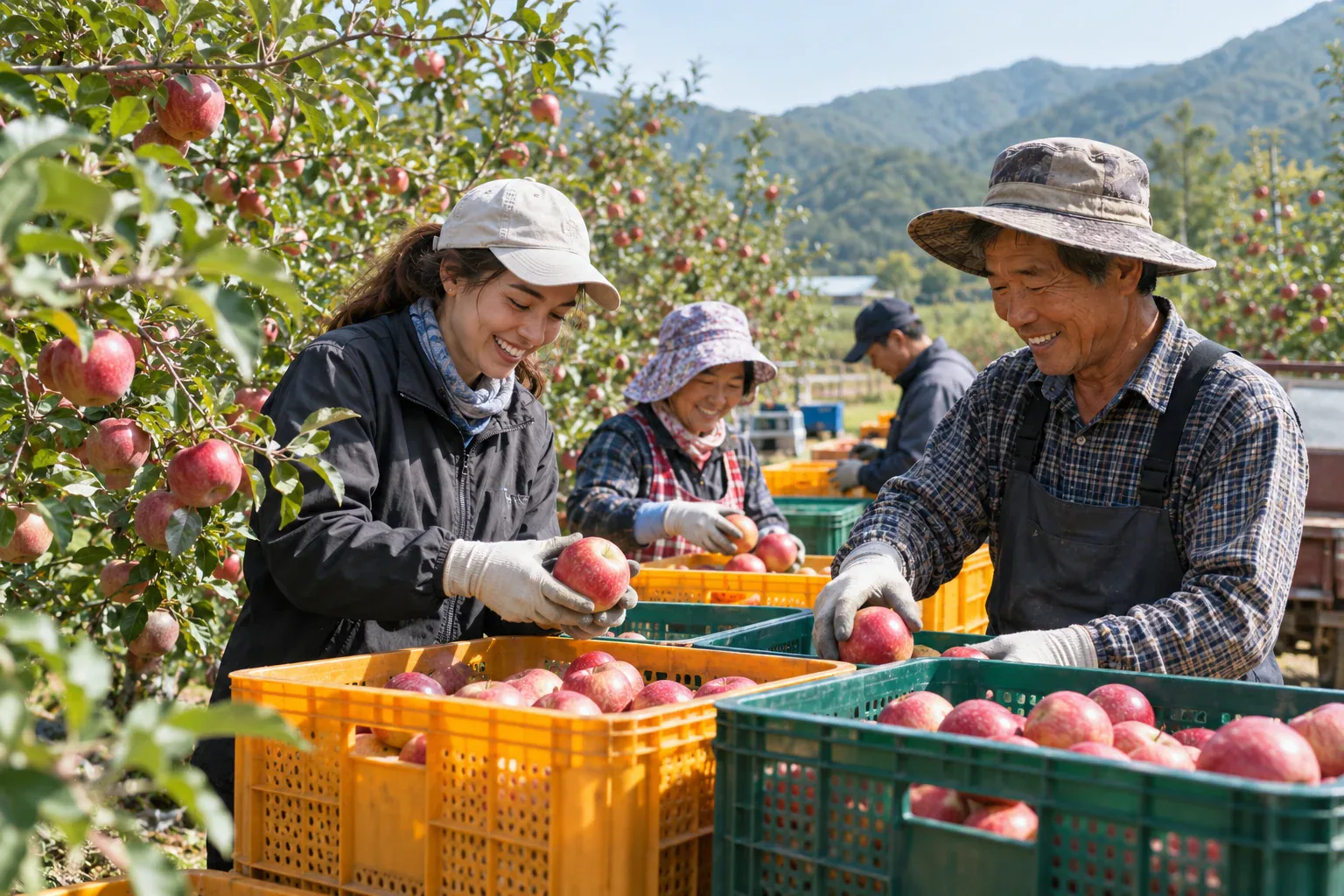
The government set a 109,000-person E-8 seasonal intake ceiling for 2026, up from 96,000 in 2025. This reflects demand for labor in farming and fishing communities. It is a different program from the professional E-7 route and the regular E-9 permit system, and it should not be presented as a year-round alternative for someone seeking an office career in Seoul.
Seasonal work can be meaningful for a worker and essential for a farm at harvest time. It also means planning around the term of work, the region, accommodation and the local recruitment arrangement. The ceiling describes capacity to bring in workers when needed; it is not a count of people already hired.
[Inline photo 2: seasonal workers sorting apples with a local farmer]
Why finding the right job is still hard
The same national survey gives a useful reality check. Among foreign respondents with job-search experience, the leading reported difficulty was insufficient information about jobs (23.7%), followed by limited Korean ability (15.9%) and a lack of suitable jobs nearby (7.6%). A role might exist in Korea but be in another province, advertised through a channel the applicant has never seen, or closed to their particular visa status.
Pay also varies too much for a single “foreigner salary” to be useful. The survey found that 526,000 foreign wage workers earned between KRW 2 million and less than KRW 3 million per month, while 387,000 earned KRW 3 million or more. Those figures cover many industries and visa types. They are a description of existing workers' monthly wages, not a salary forecast for a new E-7, E-9 or E-8 applicant.
For professional openings, start with the Study in Korea Work in Korea listings, which include an E-7 support filter, and compare them with the employer's stated occupation and sponsorship details. International students can ask their university career office about the transition from study to job-seeking or employment status. For E-9, use the official Employment Permit System and the channel for your country. For E-8, follow the relevant seasonal program and local-government arrangement. Before changing jobs, confirm the exact permitted work under your current status with the immigration authorities.
So, is teaching still the only realistic option?
No. The employment data alone settle that narrow question: foreign residents already work across factories, shops, restaurants, farms, construction sites and service businesses. Skilled roles exist too. But “there are jobs” and “I can legally take this job” are two separate questions.
The most useful way to read Korea's 2026 job market is to pair the work you can do with the route that permits you to do it. If the E-2 classroom no longer fits your plans, start with your actual skills and status, then look at the matching occupations and employers. A different job may be possible. It needs a real path, not a promising title in a search result.