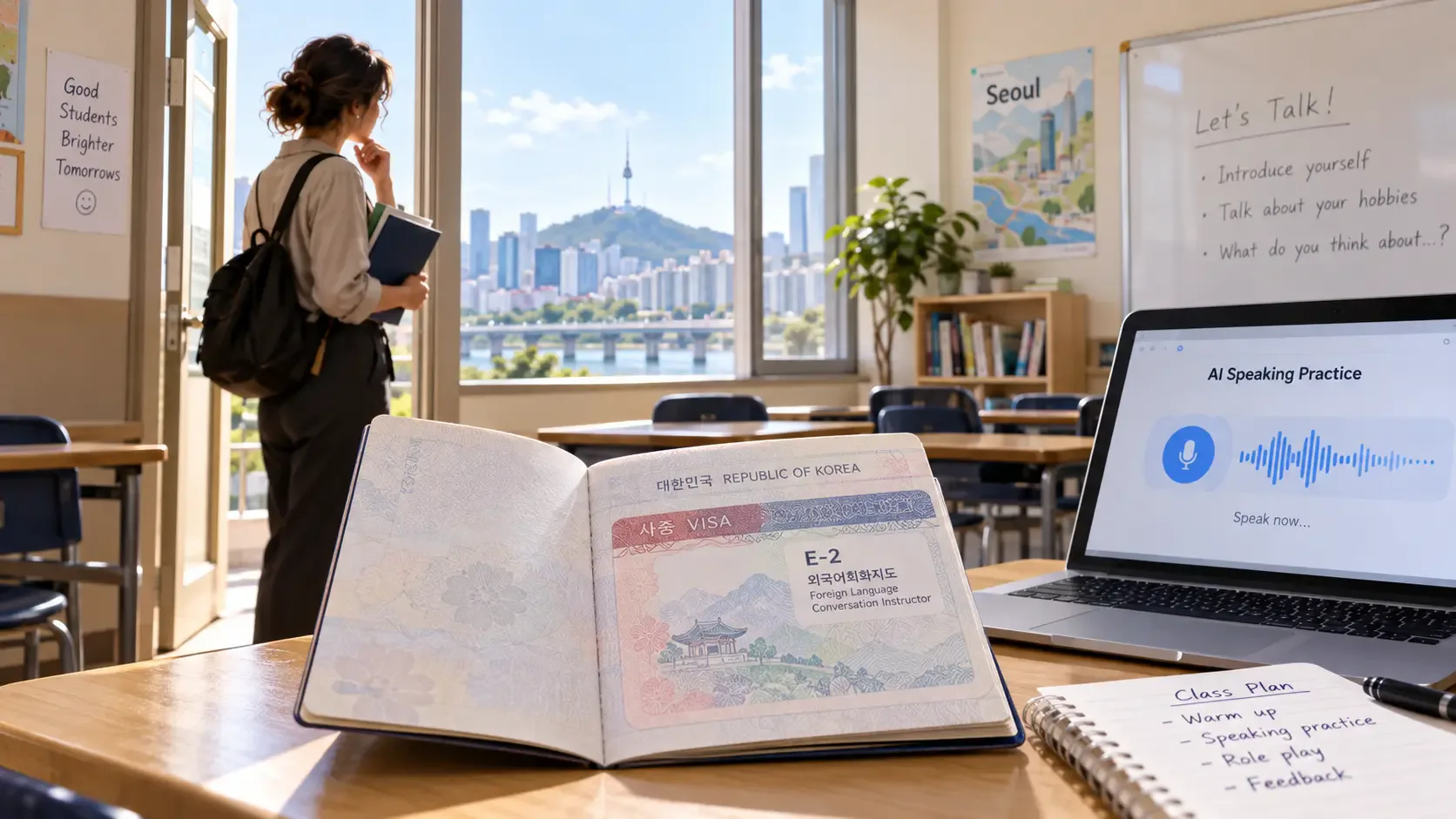
At 11 p.m. in Seoul, a learner can ask an AI app to practice a job interview, replay a phrase until the pronunciation sounds right, and open a video lesson on a phone. The next morning, a translation tool can help with an email. Each of those used to be a reason to seek a class or a tutor. If you teach English in Korea, it is fair to wonder: how much of that paid work is disappearing?
The anxiety has a concrete number behind it. Korea issued 1,286 new E-2 Foreign Language Instructor visas in the first quarter of 2026, versus 2,448 in the first quarter of 2020—a decline of 1,162, or about 47.5%. The Korea JoongAng Daily reported those figures in May after obtaining them from the Ministry of Justice, calling the latest quarter a six-year low. The drop deserves attention. It does not establish that AI eliminated 47.5% of English teaching jobs.
The full first-quarter series is more revealing: 2,448 in 2020, 1,342 in 2021, 2,113 in 2022, 1,615 in 2023, 1,557 in 2024, 1,414 in 2025 and 1,286 in 2026. The 2021 plunge was followed by a rebound in 2022, then four consecutive annual declines.
The visa signal is serious, but it is not a job-loss count
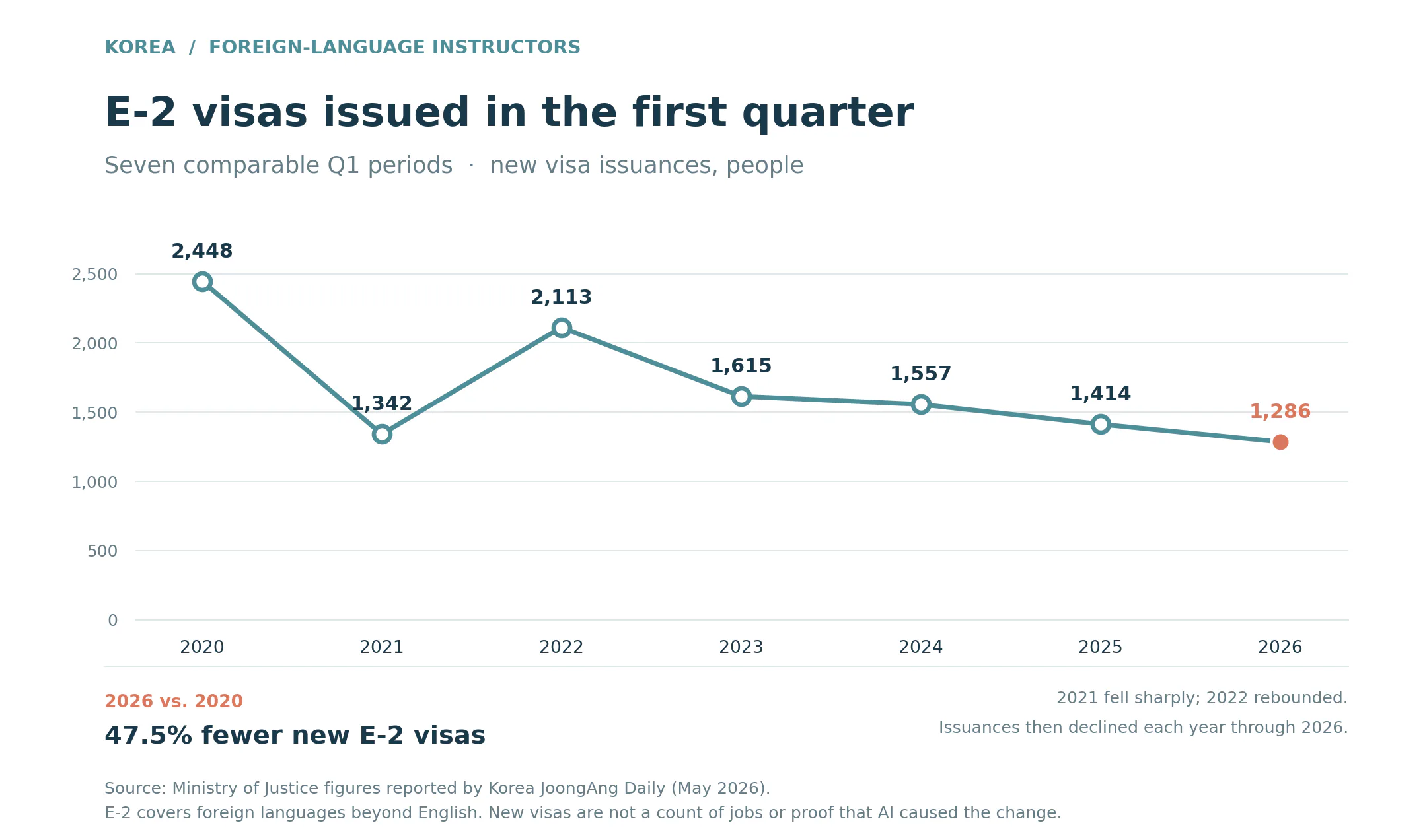
The comparison is between the same quarter in two years, not between two full-year totals. E-2 covers eligible instructors of foreign languages, not English alone. A newly issued visa is also different from the number of instructors already working in Korea: people may renew, remain in a position or teach under another eligible residence status. Korean legal guidance notes that qualifying F-2, F-4, F-5 and F-6 residents can teach without obtaining E-2. The figure therefore points to a smaller flow through one important route, while leaving the exact number of English vacancies unanswered.
It also leaves the cause unanswered. A school could recruit fewer instructors because demand weakened, because it changed its delivery model, or because a different pool of already resident teachers filled positions. The national visa total cannot tell those stories apart. Yet the direction is hard to ignore if you are planning to enter Korea on an E-2 visa.
What changed on the learner’s phone?
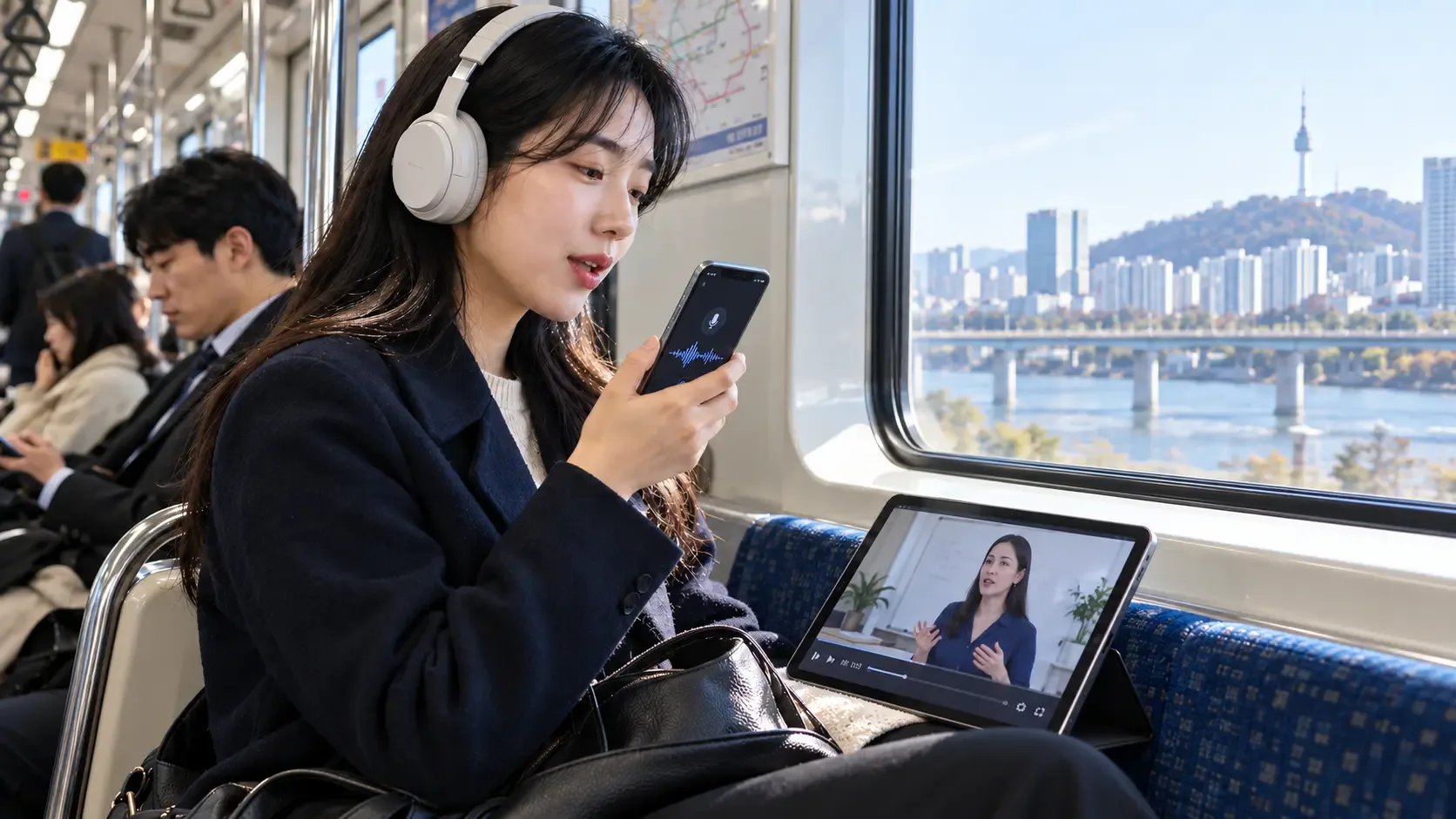
An English learner in Korea no longer has to choose between a scheduled class and doing nothing. A speaking app can simulate conversations whenever the learner has ten minutes. Video lessons can explain the same grammar point repeatedly at little or no extra cost. AI can generate a custom exercise, offer immediate feedback or translate a sentence in context. A person who mainly wants low-pressure repetition may decide that a paid beginner conversation session is less urgent. Someone who only needs occasional help reading or writing may question how much English study is necessary at all. Those are plausible pressures on parts of the market, not measured shares of displaced classes.
There are signs that this environment is real in Korea. Google Play selected the AI speaking app Speak as its 2024 Best App in Korea. Speak says users worldwide spoke 3.74 billion lines to its tutors in 2025, up 111% from 2024; that is a global product-use figure, not a Korean hiring statistic. Korea’s National Information Society Agency reported that 44.5% of respondents in its 2025 internet-use survey had experience with generative AI services. The survey also recorded 96.3% use of video services. These broad measures do not say that all those people study English, but they show how familiar the digital channels already are.
YouTube adds another route to free or on-demand instruction. A learner can follow a human English teacher’s lesson, review captions and practice a phrase; video platforms have also begun adding AI learning aids such as questions and quizzes. AI-assisted creation and dubbing can expand the supply of educational video. There is no reliable Korea-specific figure here showing how many English lessons were generated by AI or how many hagwon seats they replaced. The relevant change is practical: explanations and basic practice are easier to obtain without booking a teacher’s time.
AI is arriving alongside a smaller school-age market
Technology is only part of the pressure. In the official 2025 survey of private education for elementary, middle and high school students, Korea counted about 5.02 million students, 120,000 fewer than in 2024. Total private education spending across all subjects fell from KRW 29.2 trillion to KRW 27.5 trillion, a 5.7% decline. Participation in any private education was 75.7%, down 4.3 percentage points. Fewer children can mean a smaller potential customer base for programs built around school pupils, regardless of which app they use.

English has not vanished from household budgets. The same survey recorded KRW 131,000 per month per student averaged across all students for private English education, and KRW 281,000 among students who actually took private English lessons. Those are different denominators; neither is a foreign teacher’s salary. Together with the falling overall participation rate, they suggest a market in which a school may have to compete harder for each enrolment even while some families still spend substantially on English. The survey does not isolate E-2 instructors, adult learners or AI’s share of any decline.
At a glance — what the measures mean:
New E-2 visas, first quarter: 2,448 in 2020 and 1,286 in 2026. This is the flow through a foreign-language instructor route, not a count of English jobs.
School-age population: 5.02 million in 2025, down 120,000 from 2024. Fewer pupils reduce the potential child-focused customer base.
Private education spending, all subjects: KRW 27.5 trillion in 2025, down 5.7%. This does not measure foreign-teacher payroll.
Generative AI experience: 44.5% in the 2025 internet-use survey. This measures broad exposure to AI, not English lessons replaced.
So where does a human teacher still fit?
The most exposed part of paid instruction may be the part an app can repeat cheaply: fixed dialogues, vocabulary drills and routine corrections. That is our reading of how the tools work, not a published estimate of Korean job losses. It also does not follow that English itself has become unnecessary. Exams, interviews, presentations, workplace relationships and a child’s confidence in a real group can make fluent communication valuable even when translation handles a quick message.
A live teacher can listen to why a learner hesitates, adapt a conversation to a real goal, guide a group, decide whether automated feedback is misleading, and help a student perform under the social pressure of an actual conversation. The opportunity is to use the phone for repetition between meetings and spend paid lesson time on judgment, interaction and progress that the learner can feel. That is a stronger reason to book a teacher than another worksheet or a scripted exchange.
The likely response differs by employer. A hagwon built on generic conversation drills faces a sharper question about price and enrolment; one that can demonstrate careful feedback and live speaking outcomes may have a clearer case for its teachers. Public-school roles involve a different mix of classroom work and policy decisions. EPIK’s Spring 2027 application opened in August 2026, a reminder that an E-2 route still exists, although an open intake is no national jobs forecast. Our EPIK Spring 2027 guide covers that particular program.
For teachers, the concrete adjustment is to show the part of learning that improves because a person is present: diagnose recurring speaking problems, lead demanding real-time discussions, coach an interview or presentation, and use AI practice records to choose the next live activity. For schools, it is to measure whether students return, improve and recommend the program when AI practice is included, rather than advertise technology as if a new app alone were a teaching strategy. These are choices, not guarantees that every current position will survive.
The honest answer in 2026
Are English teaching jobs in Korea under pressure? Yes, and the E-2 issuance fall is a warning signal. Is AI the proven cause of that 47.5% fall? No. Fewer school-age students, changes in private spending, alternative visa routes and employers’ choices also matter. AI apps, on-demand videos and translation tools make some old reasons for paying a teacher less compelling, but the data available today cannot assign a job-loss percentage to AI.
The more useful question for the next few years is whether schools continue paying for live teaching that goes beyond inexpensive digital practice. Watch new visa issuances alongside actual vacancies, pay, enrolment and the use of learning apps. If those measures move together, the picture will become clearer. For now, neither “AI has ended teaching in Korea” nor “nothing has changed” fits the evidence.