Chuseok is often introduced as Korea’s Thanksgiving, and the comparison is a useful starting point: families gather, share food and give thanks for the harvest. The customs and calendar are distinctly Korean, though. If this is your first Chuseok in Korea, the holiday can feel wonderfully welcoming and surprisingly inconvenient at the same time.
In 2026, Chuseok Day is Friday, September 25. The official holiday runs from Thursday, September 24, through Saturday, September 26; with Sunday attached, many people have four days away from work. Chuseok falls on the 15th day of the eighth month of the Korean lunar calendar. It is also called Hangawi. Seoul’s holiday information and the Korea Tourism Organization’s 2026 guide confirm the dates.
Why is it called Hangawi—and is it really Thanksgiving?
The older name Hangawi evokes the middle of autumn and its abundant harvest. The holiday is traditionally associated with the bright full moon: historically, it was a time to appreciate the season’s crops, remember ancestors and wish for a good year ahead. Because the date follows the lunar calendar, Chuseok moves between September and October on the Western calendar. The Korea Tourism Organization groups it with Seollal, the Lunar New Year, as one of Korea’s two most widely celebrated traditional holidays.
“Korean Thanksgiving” explains the harvest and gratitude, but the resemblance stops short of an identical celebration. Chuseok has its own foods, family customs and remembrance traditions. Unlike Seollal’s New Year greetings and rice-cake soup, Chuseok is centered on the autumn harvest. Read the tourism organization’s cultural overview.
What do people do for Chuseok?
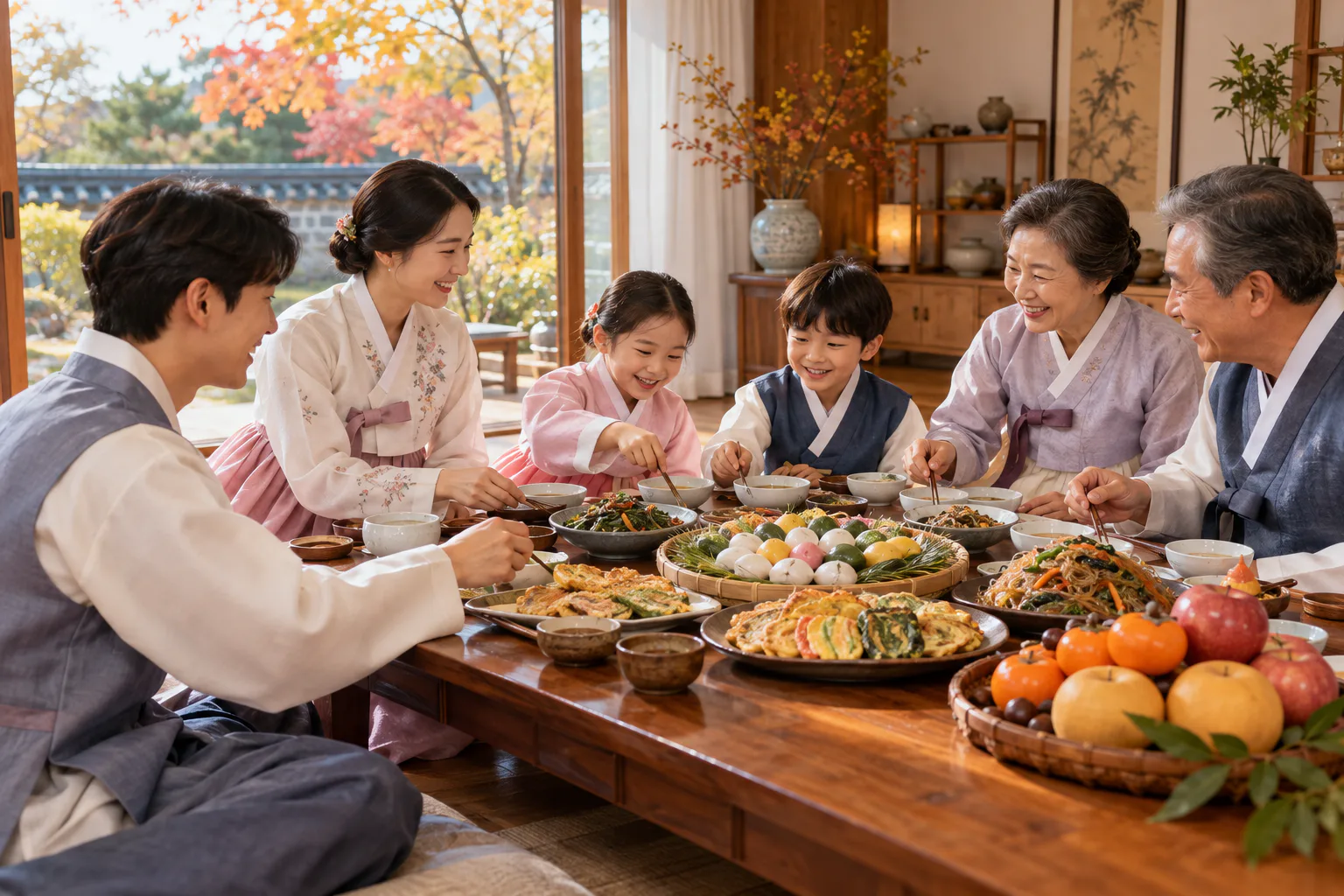
For many households, the heart of the holiday is a meal with relatives. Families may travel to their hometowns, visit ancestral graves (seongmyo) or hold a remembrance ceremony (charye). In a traditional charye, newly harvested food and songpyeon may be placed on a table to honor ancestors; afterward, relatives share the food. Practices differ from family to family, and not everyone holds a ceremony. Seoul notes that these rituals have become less common, while family reunions remain important.
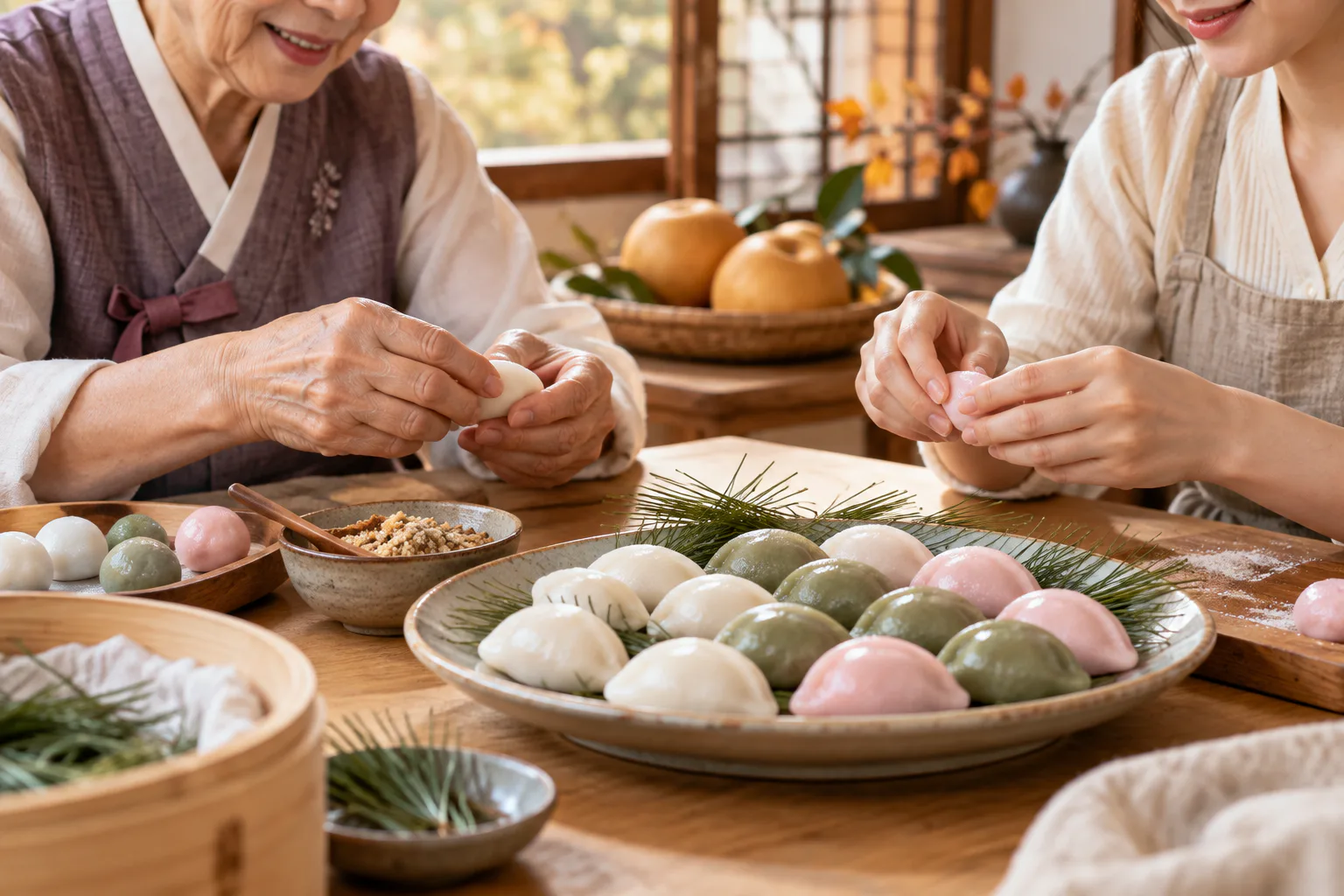
Food is another way to understand the season. Songpyeon, half-moon-shaped rice cakes with fillings such as sesame, beans or chestnuts, is closely associated with Chuseok. The cakes are traditionally steamed over pine needles, which can give them a subtle scent. Why a half moon for a full-moon holiday? One traditional interpretation sees the growing crescent as a symbol of future growth and prosperity. The Korea Tourism Organization explains the food and its meaning.
Tables may also include jeon (pan-fried meat, seafood or vegetables), japchae (glass noodles with vegetables), seasoned greens, fruit and sweets such as yakgwa. No household serves an identical menu. For some families, making songpyeon together is part of the celebration; for others, buying ready-made dishes keeps the day manageable.
More than a meal: games, music and the harvest moon
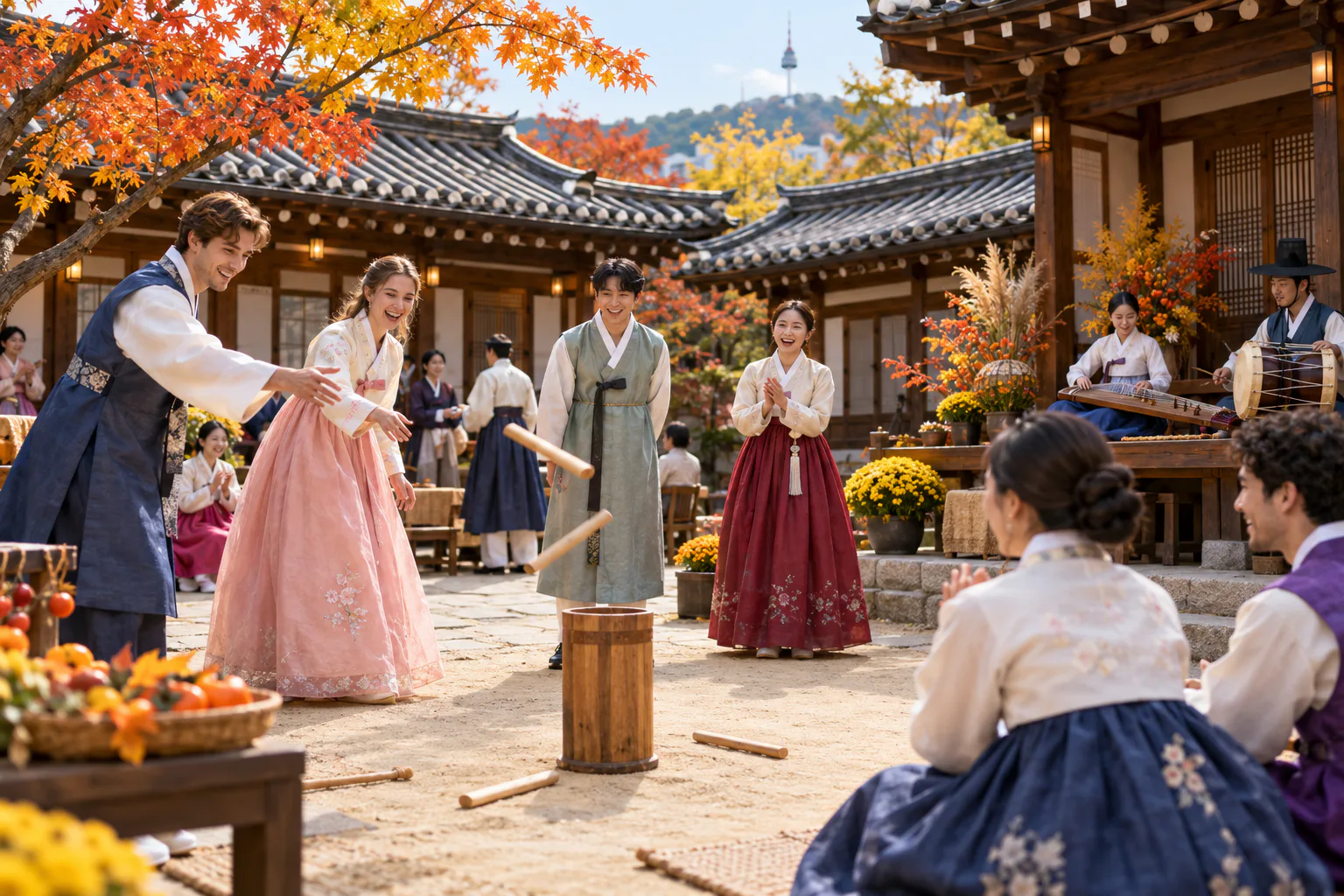
Look beyond the dining table and Chuseok becomes much livelier. Ganggangsullae is a traditional circle dance associated with the full moon and wishes for a plentiful harvest; it is recognized as UNESCO intangible cultural heritage. Jegichagi challenges players to keep a small shuttlecock in the air with their feet, while ssireum is traditional Korean wrestling. Some museums and festivals let visitors try holiday games or watch performances. A family celebrating quietly at home, however, may do none of these things. Explore the customs.
The good side: time together and a change of pace
Chuseok gives relatives who live in different cities a reason to meet. Children see grandparents, people cook together, and some families reconnect after a busy year. For a visitor or international resident invited to a family gathering, it can be an unusually personal introduction to Korean hospitality.
You do not need a family invitation to enjoy the season. Trying a piece of songpyeon, watching a folk performance or sending a simple “즐거운 추석 보내세요” (Jeulgeoun Chuseok bonaeseyo, “Have a happy Chuseok”) to a Korean friend or colleague is a natural way to join in. The phrase is an example of a friendly greeting, not a required ritual.
The holiday can also be a good time to explore Korean culture. Some palaces and cultural venues offer free entry or special programs during the break. Check the specific venue’s schedule before going: a museum that opens over the holiday may still close on Chuseok Day. Our companion guide, What to Do in Seoul During Chuseok 2026, covers confirmed Seoul events.
The difficult side: traffic, tickets and closed doors
The mass journey home is the most visible downside. A Seoul–Busan drive that might take roughly five hours in lighter traffic can stretch far longer over a holiday. For September 24, 2026, the government’s traffic forecast estimated up to 10 hours 30 minutes from Seoul to Busan by car at the busiest time. That is a forecasted peak, not the travel time every driver will experience. Return traffic was expected to be especially heavy on the afternoon of September 25. See the government’s holiday transport briefing.
Train and express bus seats are also in high demand, so a spontaneous intercity trip may be difficult. In Seoul, subway and city bus services continue, with some late-night services extended for returning travelers. You can check Seoul TOPIS for current road conditions.
Another surprise is how many everyday plans need checking. The Korea Tourism Organization warns that many restaurants, department stores and shopping malls close on Chuseok Day or for part of the holiday. That does not mean the whole city shuts down: convenience stores and businesses near visitor areas may remain open. Check the individual listing, call ahead if a meal matters to you, and allow a backup option.
Family gatherings can have a less visible cost, too. Long travel, food preparation, gifts and expectations about attending can feel demanding. A holiday table takes time and money, and the work of preparing it is not always shared equally. There is no single “right” way a household celebrates: some keep the meal simple, meet briefly, travel elsewhere or spend the break resting.
A quick plan for your first Chuseok
If you are traveling between cities: Reserve a train or bus as early as possible, and check live traffic before a road trip.
If you are staying in Seoul: Save a few confirmed open restaurants and attractions before the holiday.
If you are invited to someone’s home: Ask about timing and what to bring; enjoying the meal and following your host’s lead is enough.
If you want a taste of the holiday: Try songpyeon or a local cultural program; you do not need to perform a family rite to appreciate the tradition.
If plans change: The multilingual Korea Travel Helpline is available at 1330 (VisitKorea).
Chuseok is both a warm family celebration and a major nationwide travel period. Expecting both sides makes the holiday much easier to enjoy.