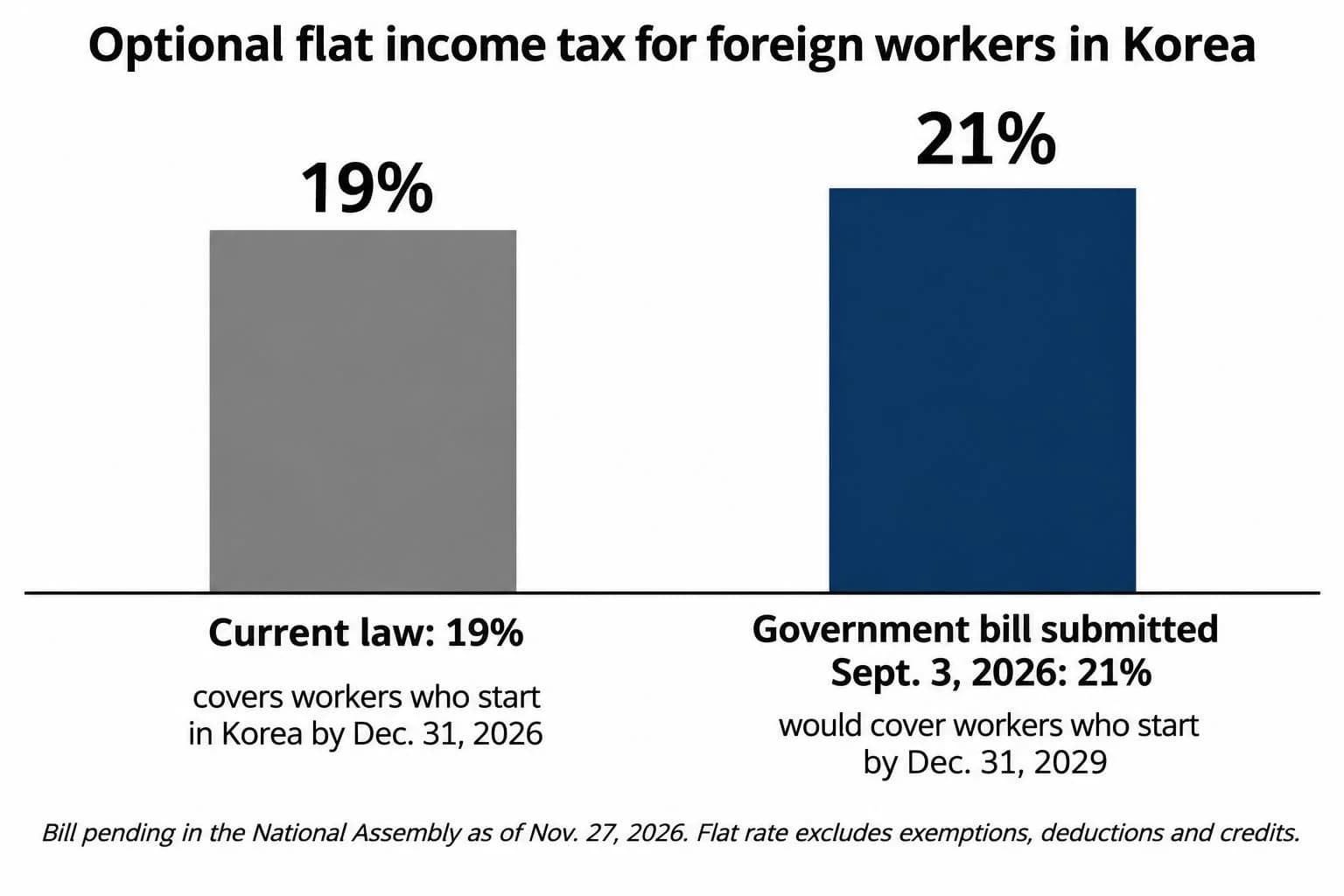
Foreign employees in Korea have two deadlines this month. The first is Dec. 18, when the National Tax Service (NTS) closes its year-end settlement preview on Hometax. The preview opened Oct. 28 and estimates the tax refund or bill from the settlement your employer will run in early 2027 on 2026 wages. The second is Dec. 31. Spending and savings made after that date do not count toward 2026 deductions. A related change is still pending. A government tax bill sent to the National Assembly on Sept. 3, 2026, would raise the optional flat tax rate for foreign workers from 19% to 21%. As of Nov. 27, we could not confirm that lawmakers have passed it.
Run the preview before Dec. 18
The preview uses your card spending from January through September and the deductions you claimed last year to estimate your result. According to Korea Tax Times' report on the NTS preview service, it works in three steps:

- Load last year's withholding statement.
- Enter your expected 2026 gross pay and the tax already withheld.
- Add your expected spending for October through December.
You can then enter yearly amounts for medical, education, insurance and housing costs. The NTS says the result is only an estimate. It also says some card totals may be missing because card companies submit data late. Those totals are added to the simplified data service in January. You need to log in with a joint certificate or simple authentication. For help in English, call the NTS helpline for foreigners at 1588-0560.
Changes that apply to 2026 wages
Foreign workers who count as Korean tax residents use the same deductions as Korean workers. You are a resident if you have an address in Korea or have lived here for at least 183 days. The changes below are new for the 2026 tax year. They do not apply if you choose the flat rate.

| Item | What changed | Condition |
|---|---|---|
| Card spending deduction limit | 3,000,000 basic; 3,500,000 with one child; 4,000,000 with two or more | Gross pay of 70 million or less (above that: 2.5M / 2.75M / 3M) |
| Education tax credit | A child's income no longer disqualifies their tuition | Covers university students who earn from part-time jobs |
| Arts and sports academy fees | Now eligible | Children under 9, or in grade 2 or below |
| Monthly rent credit | Extended to a spouse living in a different city or district | Spouse earns 80 million or less; combined limit 10 million rent a year |
| Hometown Love donations | Credit rate on amounts over 100,000 up to 200,000 raised to 40% | Donations made in 2026 |
How you pay still matters. Credit card spending is deducted at 15%. Debit cards and cash receipts get 30%, and public transit and traditional markets get 40%. Culture and sports spending gets 30% if your gross pay is 70 million won or less. Spending on a card abroad does not count. Medical bills from overseas hospitals and school fees for children studying abroad are not deductible either.
Gather documents from home now
Residents can claim a spouse living in their home country if the spouse earns no more than 1 million won a year. You need home-government documents that show the relationship and the spouse's income, such as a marriage or family relation certificate. To claim parents or children abroad, you also need proof that you support them, such as records of money you sent. Since last cycle, residents earning 70 million won or less who are the spouse of a homeless head of household can deduct 40% of housing subscription savings, up to 3 million won a year. Nonresidents still settle their Korean wages but lose most deductions.

The flat-rate question
Under Article 18-2 of the Restriction of Special Taxation Act, foreign workers can choose a 19% flat rate instead of the regular income tax brackets. The option lasts up to 20 years from their first day of work in Korea. In return, they give up tax exemptions, deductions and credits. The current law covers only workers who start working in Korea by Dec. 31, 2026. The NTS says the flat rate is not better for everyone, so compare both methods before you choose.
| Item | Current law | Government bill |
|---|---|---|
| Flat rate | 19% | 21% |
| Covers workers who start in Korea by | Dec. 31, 2026 | Dec. 31, 2029 |
Bae, Kim & Lee's October 2026 analysis of the tax reform bill expects the tax bills to be finalized with the budget in December. The firm's summary does not say when a 21% rate would take effect. The same bill would also tighten the separate 50% tax cut for foreign engineers and researchers. It would require a doctorate in science, engineering or medicine, and only at qualifying strategic-technology employers. That change would apply to employment contracts signed on or after April 1, 2027. If you are starting a job in Korea around the new year, ask your employer's payroll team which rules will apply to you once the National Assembly votes.