
Three changes kick in on January 1, 2027 that will show up in foreign residents' paychecks, plus one entry rule that won't change after all. The hourly minimum wage goes to 10,700 won and the national pension rate goes up to 10% of monthly income. The long-term care premium increases, but the health insurance rate stays where it is. Part-time workers will also see a new employment insurance rule. On the travel side, the Ministry of Justice said on November 23, 2026 that visitors from 22 countries and regions can keep entering without a K-ETA through December 31, 2027.
Short-term visitors: the K-ETA exemption runs another year
If your passport is on the exempt list, you can keep traveling without a K-ETA in 2027. The list has 22 countries and regions, including the US, UK, Japan and Australia. The Ministry of Justice's K-ETA extension notice says the exemption now runs until December 31, 2027 (Korea time) and is meant to support tourism. If you're unsure whether you qualify, start a K-ETA application. When you scan your passport photo page, a pop-up will tell you if you're exempt. Visa-free travelers from countries not on the list still need K-ETA approval before boarding a flight or ship to Korea. An approval is generally valid for three years, but not past your passport's expiry date. The exemption only covers K-ETA. It doesn't change how long you can stay, which depends on your nationality.
Workers: minimum wage goes to 10,700 won an hour
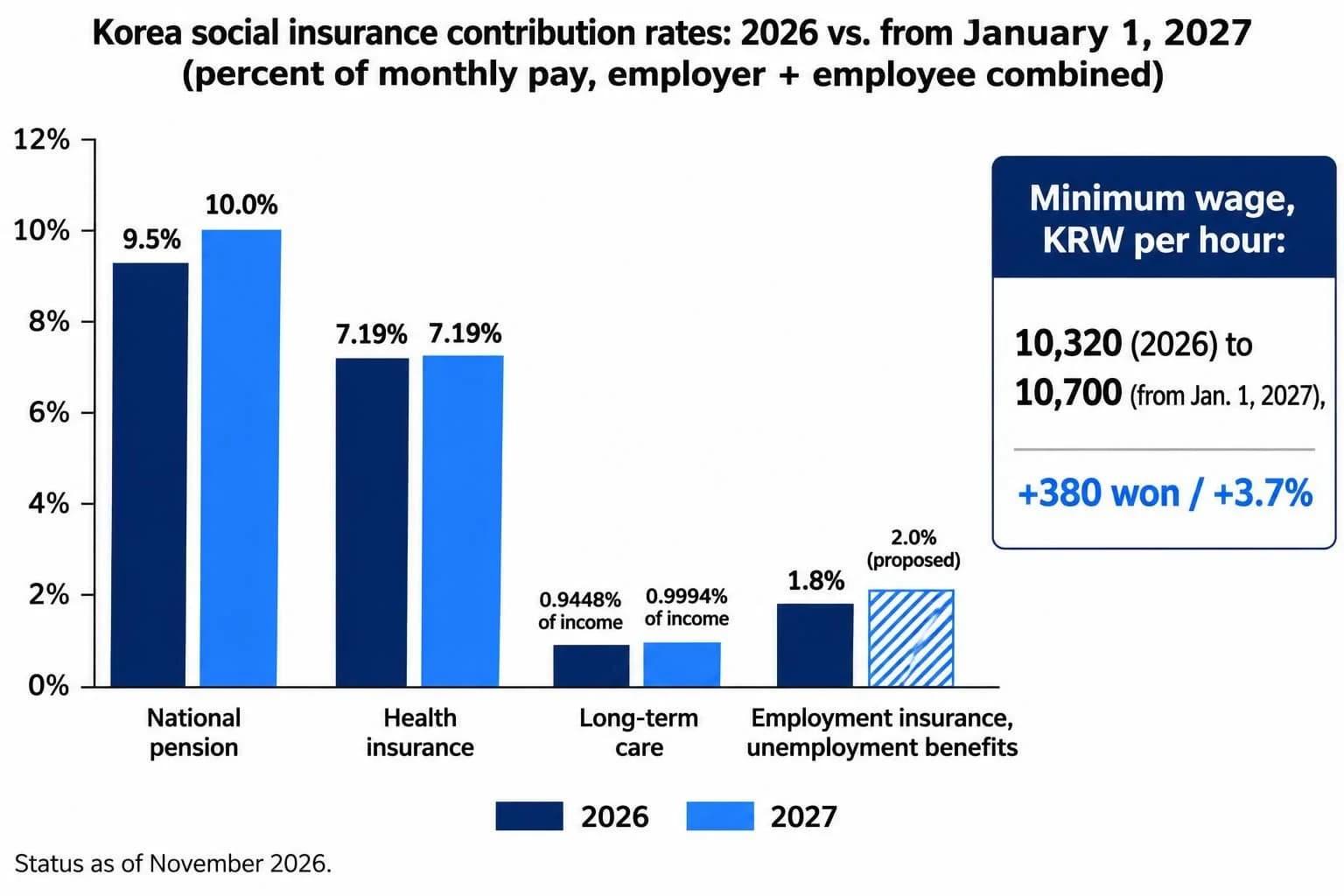
From January 1, every hourly wage in Korea has to be at least 10,700 won. That's 380 won (3.7%) more than the 2026 rate of 10,320 won. The Ministry of Employment and Labor finalized the rate on August 5, 2026, in its official 2027 minimum wage announcement. For a 40-hour week (209 paid hours a month), the minimum works out to 2,236,300 won a month. The same rate applies to every workplace, whatever the industry, and there's no separate rate for contract-based pay. If you're paid by the hour, compare your first January payslip with the new rate.

Payroll deductions: pension up, health insurance unchanged
Expect slightly larger deductions on January payslips, mainly because of the pension. Under the 2025 pension reform, the rate rises by 0.5 percentage points a year until it reaches 13% in 2033, as the government's policy briefing on the pension reform explains. On September 8, 2026, the health insurance policy committee held the health insurance rate at 7.19%. It also kept the per-point charge on property for locally enrolled members at 211.5 won. The long-term care rate, approved on October 30, 2026, goes up.
| Item | 2026 | From Jan. 1, 2027 | Status (as of Nov. 2026) |
|---|---|---|---|
| National pension | 9.5% (4.75%) | 10.0% (5.0%) | Set by law |
| Health insurance | 7.19% (3.595%) | 7.19% | Frozen on Sept. 8, 2026 |
| Long-term care (as a share of income) | 0.9448% | 0.9994% (13.90% of the health premium) | Approved Oct. 30, 2026 |
| Employment insurance, unemployment benefits | 1.8% (0.9%) | 2.0% (1.0%) proposed | Draft decree, not final |
Here's a simple example: a 3 million won monthly salary with no tax-free allowances. The employee's pension deduction rises from 142,500 won to 150,000 won. Health insurance stays at 107,850 won, and long-term care goes from about 14,170 won to about 14,990 won. Employers pay at least the same amount on top. Whether you have to join the national pension at all depends on your nationality, your status of stay and your home country's system. If you're not sure, ask your payroll team before January.
Part-timers: employment insurance coverage now depends on pay
Starting January 1, 2027, the amended Employment Insurance Act decides who is excluded based on pay instead of hours. Until now, anyone scheduled for under 60 hours a month (under 15 hours a week) was excluded. The pay threshold will be set by enforcement decree. A draft issued July 10, 2026 proposes 800,000 won a month, but it hadn't been finalized by mid-November. Some people are covered even if they earn less:
- daily workers
- people who have worked at the same business for three months or more
- people with two or more jobs at once who apply to combine their pay to reach the threshold (new in 2027)
If you were already insured before January 1, you keep that coverage under the old rules until you first leave the job, according to a labor attorney's breakdown of the amended act. A separate draft announced September 22, 2026 would raise the unemployment benefit rate shown in the table. Neither draft was final when this article was written.
Foreign nationals face one more step. The labor ministry's answer on foreign workers and employment insurance says coverage depends on your status of stay. Depending on your visa, enrollment is mandatory, optional or not available, so the new pay threshold only matters if your visa allows you to enroll.
Still pending
Tax changes for 2027 hadn't been finalized when we checked, so they're not included here. Once the employment insurance decrees are published, check your January payslip against the final pay threshold and rate.